
Introduction
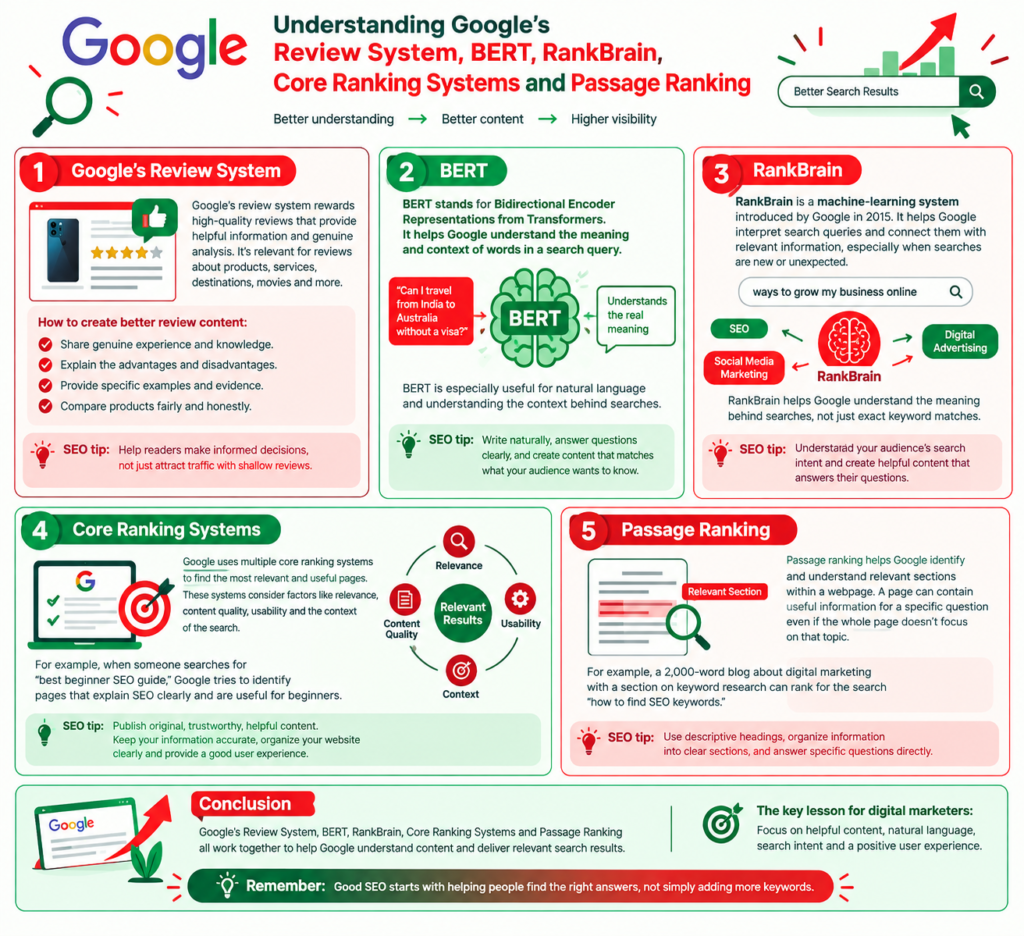
Have you ever wondered how Google decides which website appears at the top of search results? Behind every search, Google uses several systems to understand content, identify relevant information, and provide useful answers. Some important systems and technologies include the Review System, BERT, RankBrain, Core Ranking Systems, and Passage Ranking.
For students, bloggers, and digital marketers, understanding these concepts is important for learning SEO and improving website visibility. Let’s explore how each one works in simple words.
1. Google’s Review System
Google’s review system is designed to reward high-quality reviews that provide helpful information and genuine analysis. It is particularly relevant to content that reviews products, services, destinations, movies, and other items.
For example, imagine a blogger reviewing a smartphone. Instead of simply writing that the phone is good, the blogger explains its camera quality, battery life, performance, advantages, and disadvantages. This gives readers useful information to make a decision.
How to create better review content:
Share genuine experience and knowledge.
Explain the advantages and disadvantages.
Provide specific examples and evidence.
Compare products fairly and honestly.
The goal is to help readers make informed decisions rather than publish shallow reviews created only to attract traffic.
2. BERT: Understanding the Meaning of Words
BERT stands for Bidirectional Encoder Representations from Transformers. Google introduced BERT to improve its understanding of language and the context of words in a search query.
For example, consider someone searching for “Can I travel from India to Australia without a visa?” Understanding the relationships between words helps Google interpret the question more accurately than simply matching individual keywords.
BERT helps Google understand how words relate to one another within a sentence. It is especially useful for interpreting natural language and the context behind searches.
SEO tip: Write naturally, answer questions clearly, and create content that matches what your audience actually wants to know.
3. RankBrain: Understanding Search Intent
RankBrain is a machine-learning system introduced by Google in 2015. It helps Google interpret search queries and connect them with relevant information, especially when searches are unfamiliar or expressed in unexpected ways.
For example, when someone searches for “ways to grow my business online,” Google can interpret the topic and identify relevant content about SEO, social media marketing, and digital advertising.
RankBrain helps Google understand the meaning behind searches rather than relying only on exact keyword matches.
SEO tip: Understand your audience’s search intent and create helpful content that answers their questions.
4. Core Ranking Systems: Finding Relevant Results
Google uses multiple core ranking systems to identify the most relevant and useful pages for a search. These systems consider many signals and factors, such as relevance, content quality, usability, and the context of the search.
For example, if someone searches for “best beginner SEO guide,” Google tries to identify pages that explain SEO clearly and provide useful information for beginners.
Google regularly improves its ranking systems through core updates. These updates can change how pages perform in search results.
SEO tip: Publish original, trustworthy, helpful content. Keep your information accurate, organize your website clearly, and provide a good experience for visitors.
5. Passage Ranking: Understanding Specific Sections
Passage ranking helps Google identify and understand relevant sections within a webpage. This means a page can contain useful information for a specific question even if the entire page does not focus exclusively on that question.
For example, imagine a 2,000-word blog about digital marketing that includes a detailed section explaining keyword research. If someone searches for “how to find SEO keywords,” Google may identify that particular section as relevant to the query.
Passage ranking does not require website owners to create a separate page for every small question.
SEO tip: Use descriptive headings, organize information into clear sections, and answer specific questions directly.
Conclusion
Google’s Review System, BERT, RankBrain, Core Ranking Systems, and Passage Ranking serve different purposes in helping Google understand content and deliver relevant search results.
For digital marketers, the key lesson is to focus on helpful content, natural language, search intent, and a positive user experience. No single system guarantees a top ranking. Instead of trying to manipulate Google’s algorithms, understand your audience and provide the information they need.
Remember: Good SEO starts with helping people find the right answers, not simply adding more keywords.